
Who Were the Irish Druids? History, Beliefs, Rituals and Ancient Traditions Explained
The Irish Druids were the educated elite of ancient Celtic Ireland, serving as priests, judges, teachers, poets, healers and advisers to kings. Active during the Iron Age and early historic period, they preserved laws, history and religious traditions through oral teaching, as they left no written records of their own.
Few figures from Ireland’s ancient past have captured the imagination quite like the Irish Druids. Revered as wise men, priests, judges, healers, poets and advisers to kings, they stood at the heart of Celtic society for centuries before the arrival of Christianity. Yet despite their importance, the Druids remain one of Ireland’s greatest historical mysteries.
Unlike later Christian monks, the Druids left behind no written books, no sacred scriptures and no first-hand accounts of their beliefs. Much of what we know comes from Roman writers, medieval Irish manuscripts written centuries later, archaeological discoveries and Ireland’s rich body of mythology and folklore. This has left historians with an intriguing puzzle, separating historical fact from legend.
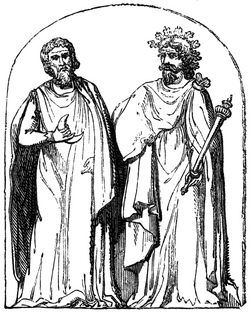
So, who were the Irish Druids in Ireland?
The evidence suggests they were far more than priests. Druids acted as judges who interpreted ancient laws, teachers who educated the next generation, poets who preserved Ireland’s history through oral tradition, physicians skilled in herbal medicine, and spiritual leaders who oversaw ceremonies marking the changing seasons. Their influence reached every level of society, from ordinary farming communities to the courts of Ireland’s High Kings.
Today, their legacy lives on in Ireland’s myths, sacred landscapes, place names and archaeological monuments. Ancient sites such as the Hill of Tara, Hill of Uisneach and Tlachtga continue to attract visitors eager to discover the spiritual world of Ireland before Christianity.
In this comprehensive guide, we’ll explore everything historians currently know about the Irish Druids.
You’ll discover where they came from, how they were trained, what they believed, the ceremonies they performed, their role in ancient Irish society, the famous Druids of Irish mythology, and what archaeological evidence reveals about these remarkable figures. Along the way, we’ll separate popular myths from historical evidence, giving you a balanced picture of one of Ireland’s most fascinating ancient traditions.
Whether you’re interested in Irish history, Celtic mythology, archaeology or your own Irish heritage, this guide will help you understand why the Druids continue to inspire curiosity more than two thousand years after they first appeared in the historical record.
Map of Important Druidic Locations in Ireland
The following places are closely associated with Ireland’s ancient religious and ceremonial traditions. While not all can be proven to have been exclusively “Druid sites”, they played significant roles in Iron Age and early medieval Ireland.
| Location | County | Why it Matters |
|---|---|---|
| Hill of Tara | Meath | Traditional seat of the High Kings and an important ceremonial centre. |
| Hill of Uisneach | Westmeath | Considered the spiritual centre of ancient Ireland and closely associated with the festival of Bealtaine. |
| Tlachtga | Meath | Traditionally linked with Samhain celebrations and the legendary druidess Tlachtga. |
| Cruachán | Roscommon | Ancient royal complex associated with the Otherworld and Celtic mythology. |
| Emain Macha | Armagh | Capital of Ulster in Irish mythology and home of the legendary druid Cathbad. |
| Newgrange | Meath | Built long before the Druids, but likely remained a place of spiritual importance during the Iron Age. |
| Loughcrew Cairns | Meath | Neolithic passage tombs aligned with the rising sun and later incorporated into Irish folklore. |
Timeline of Druidic History
c. 5000–3000 BC
Monumental sites such as Newgrange, Knowth and Loughcrew are built during the Neolithic period, thousands of years before the historical Druids.
c. 800 BC
The Iron Age begins in Ireland, bringing significant cultural and technological changes.
c. 300–100 BC
The earliest historical references to Druids emerge in the wider Celtic world through Greek and Roman writers.
1st Century AD
Roman authors describe Druids as religious leaders, judges and scholars among Celtic societies.
5th Century AD
Christianity spreads across Ireland. Traditional Druidic influence gradually declines as monasteries become centres of learning.
7th–12th Centuries AD
Irish monks record many ancient myths, preserving stories of legendary Druids such as Cathbad and Mug Ruith, ensuring that memories of Ireland’s pre-Christian past survive into the modern age.
What Did Irish Druids Actually Do?
The Irish Druids were far more than religious leaders. In ancient Celtic society, an educated class emerged whose influence extended to law, politics, education, medicine, poetry and spirituality. Rather than holding a single role, Druids served as advisers, teachers, and guardians of knowledge, making them among the most respected people in Iron Age Ireland.
Although much of what we know comes from Roman accounts, medieval Irish literature and archaeology rather than Druidic writings themselves, several key responsibilities are consistently associated with them.
Religious Leaders
Druids conducted sacred ceremonies and seasonal festivals, including Samhain, Bealtaine, Imbolc and Lughnasadh. They were believed to communicate with the gods, offer blessings, interpret signs from nature and oversee rituals that marked important moments in the agricultural and spiritual calendar.
Advisers to Kings
Many Irish legends describe Druids serving as trusted counsellors to kings and chieftains. They advised rulers on matters of justice, diplomacy, warfare and religious observance, and were often consulted before major decisions affecting the kingdom.
Judges and Legal Experts
Before written law codes became common, Druids were responsible for preserving and interpreting customary law through oral tradition. While the professional legal class later became known as the Brehons, early traditions suggest that Druids also played an important role in resolving disputes and maintaining social order.
Teachers and Keepers of Knowledge
Druids were the educators of ancient Ireland. They taught history, genealogy, law, poetry, astronomy, philosophy and religious beliefs, passing knowledge from one generation to the next entirely through memorisation. Training to become a Druid may have taken many years, reflecting the vast amount of knowledge they were expected to master.
Poets and Historians
In a society without written histories, Druids helped preserve Ireland’s past through storytelling and oral tradition. They memorised family lineages, heroic tales and important historical events, ensuring that knowledge survived long before it was eventually written down by medieval monks.
Healers and Naturalists
Many traditions associate Druids with herbal medicine and a deep understanding of the natural world. They were thought to study plants, trees, animals and the changing seasons, using this knowledge to treat illness and guide agricultural practices.
Diviners and Spiritual Guides
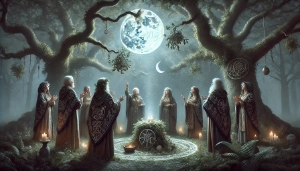
Irish mythology often portrays Druids as interpreters of dreams, omens and signs from nature. Birds, the stars, weather patterns and sacred landscapes were believed to reveal messages about the future or the will of the gods. While these accounts are rooted in legend, they reflect the important spiritual role Druids held within ancient Irish society.
A Remarkable Influence
Taken together, these responsibilities show that the Irish Druids were among the most influential members of their communities. They combined the roles of priest, scholar, judge, physician, historian and royal adviser, shaping nearly every aspect of life in pre Christian Ireland. Although many details of their practices have been lost to history, their legacy continues through Ireland’s mythology, folklore and ancient ceremonial sites.
What Did Irish Druids Believe?
The beliefs of the Irish Druids were deeply rooted in nature, the cycles of the seasons and a spiritual world that existed alongside everyday life. Because the Druids left no written records of their own, our understanding comes from Roman writers, medieval Irish manuscripts, archaeology and the rich traditions of Irish mythology. While many details remain uncertain, historians have identified several core beliefs that appear to have been central to Druidic spirituality.
The Sacredness of Nature
Druids viewed the natural world as a living, sacred place. Forests, rivers, mountains, springs and ancient trees were believed to possess spiritual significance. Rather than worshipping nature itself, they are thought to have regarded it as a place where the divine could be experienced and where ceremonies were held.
A World Filled with Spirits
Ancient Irish tradition describes a landscape inhabited by gods, ancestors and supernatural beings. The Druids believed that the physical world and the Otherworld were closely connected, with certain places and times, particularly during festivals such as Samhain, allowing the boundary between the two to become thinner.
Many Gods, Many Powers
Before Christianity, Ireland followed a polytheistic religion, meaning people honoured many gods and goddesses. Figures such as the Dagda, Brigid, Lugh and The Morrígan were associated with wisdom, healing, craftsmanship, fertility, kingship and warfare. Druids likely acted as intermediaries during ceremonies dedicated to these deities.
The Importance of Knowledge
Knowledge was considered sacred. Druids spent years memorising laws, history, poetry, genealogy and religious teachings, believing that wisdom was one of the greatest sources of power and responsibility. This emphasis on learning made them the intellectual leaders of ancient Irish society.
Life Beyond Death
Many classical writers claimed that Druids believed the soul continued after death, although exactly how this was understood in Ireland is uncertain. Irish mythology often speaks of the Otherworld, a timeless realm of beauty and abundance where heroes, gods and spirits could dwell, suggesting that death was viewed as a transition rather than an end.
A Belief System Shaped by Mystery
Much about Druidic belief has been lost over the centuries, and historians continue to debate many aspects of their religion. However, the surviving evidence points to a spiritual tradition centred on respect for nature, reverence for wisdom, honouring the gods and maintaining harmony between the human world and the unseen realm. It is this blend of history, archaeology and mythology that continues to make the beliefs of the Irish Druids one of the most fascinating subjects in Ireland’s ancient past.
Myths vs Facts
The Irish Druids have inspired countless books, films and modern legends, but many popular beliefs are not supported by historical evidence. Because the Druids left no written records of their own, much of what we know comes from Roman writers, early Irish literature and archaeology. This makes it important to separate well supported facts from later folklore and speculation.
| Myth | Fact |
|---|---|
| Druids were simply priests. | Druids fulfilled many roles in ancient Irish society. They were religious leaders, but also acted as judges, teachers, advisers, poets and keepers of knowledge. |
| Druids built Stonehenge and Newgrange. | There is no evidence that Druids built these monuments. Sites such as Newgrange were constructed more than 2,000 years before the historical Druids appeared. They may, however, have used these ancient places for ceremonies. |
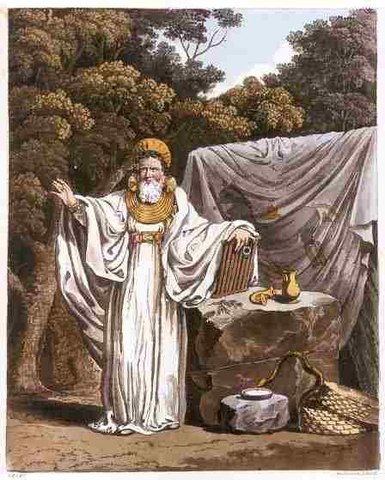
| All Druids wore white robes. | The familiar image of white robed Druids comes mainly from Roman descriptions and later artistic depictions. There is no archaeological evidence showing that all Irish Druids dressed this way. |
| Druids constantly practised magic. | Irish mythology often attributes supernatural powers to Druids, including prophecy and shape shifting. These stories are an important part of Irish folklore, but they should not be treated as historical fact. |
| Druids left behind sacred books. | The Druids relied almost entirely on oral tradition. Knowledge was memorised and passed from teacher to student over many years rather than written down. |
| Christianity wiped out all traces of the Druids overnight. | The decline of the Druids was gradual. As Christianity spread across Ireland, many old customs evolved rather than disappeared completely. Elements of pre Christian tradition survived in folklore, seasonal festivals and medieval literature. |
| Everything written about the Druids is historically accurate. | Much of the surviving information was written by outsiders, particularly Roman authors, or by Christian monks centuries after the Druids had disappeared. Historians compare these sources with archaeology to build the most reliable picture possible. |
Why It Matters
Understanding the difference between myth and historical evidence helps us appreciate the Irish Druids for who they really were. While legends have added mystery and magic to their story, the historical Druids were already remarkable, serving as the scholars, spiritual leaders, legal experts and guardians of knowledge in ancient Ireland. By separating folklore from fact, we gain a clearer picture of one of the most influential groups in Ireland’s early history while still appreciating the rich mythology that surrounds them.
Are Modern Druids the Same?
The short answer is no. While modern Druidry draws inspiration from ancient Celtic traditions, it is not a direct continuation of the religion practised by the Irish Druids over two thousand years ago. The original Druidic tradition disappeared as Christianity spread through Ireland, and because the Druids left no written records, many details of their beliefs and practices were lost.
Modern Druidry began to emerge during the 18th and 19th centuries, inspired by growing interest in Celtic history, folklore and archaeology. Early revival movements often blended historical research with Romantic ideas, creating new ceremonies and traditions based on what people believed ancient Druids might have practised. Today’s Druids generally view nature as sacred, celebrate the changing seasons and seek a spiritual connection with the natural world, but their beliefs and rituals vary widely between different groups and individuals.
Ancient Irish Druids, by contrast, were an integral part of Iron Age society. They served as judges, teachers, advisers to kings, poets and religious leaders, holding positions of authority within their communities. Their role extended far beyond spirituality, influencing law, education and politics.
Modern Druids do not claim to hold the same social or political influence. Instead, many focus on personal spirituality, environmental awareness, cultural heritage and celebrating ancient Celtic traditions. Some identify with Paganism, while others see Druidry as a philosophical or cultural path rather than a religion.
Ancient Druids vs Modern Druids
| Ancient Irish Druids | Modern Druids |
|---|---|
| Lived during the Iron Age and early historic period. | Revival movement that developed mainly from the 18th century onwards. |
| Held positions as priests, judges, teachers, poets and royal advisers. | Focus primarily on spirituality, nature and personal practice. |
| Passed knowledge through oral tradition. | Draw on historical research, folklore and modern interpretations. |
| Were part of ancient Celtic society. | Practised around the world by people with a wide range of beliefs. |
| Left no written records of their own. | Produce books, websites and educational resources about their beliefs. |
A Living Tradition Inspired by the Past
Although modern Druidry is not the same as the ancient tradition, it reflects a continuing fascination with Ireland’s pre-Christian heritage. Many people are inspired by the Druids’ respect for nature, their pursuit of knowledge and their connection to the changing seasons. While historians continue to uncover new evidence about the original Irish Druids, modern practitioners keep the spirit of curiosity and appreciation for the natural world alive in their own way.
Summary
The Irish Druids were among the most influential figures in ancient Ireland, serving not only as spiritual leaders but also as judges, teachers, healers, poets and trusted advisers to kings. Although they left no written records of their own, evidence from archaeology, Roman accounts and medieval Irish manuscripts paints a picture of a highly respected class that shaped many aspects of Celtic society.
Their beliefs centred on the sacredness of nature, the importance of wisdom and learning, and the close relationship between the physical world and the Otherworld. They celebrated seasonal festivals, preserved history through oral tradition and acted as guardians of customs that defined life in pre-Christian Ireland.
Over the centuries, the Druids have become surrounded by myths and legends. While stories of powerful magic and supernatural abilities continue to capture the imagination, historians work carefully to distinguish folklore from evidence. This balanced approach reveals that the real Druids were every bit as fascinating as the legendary figures who appear in Irish mythology.
Although the ancient Druidic tradition faded with the spread of Christianity, its influence can still be seen across Ireland today. Sacred hills, ancient monuments, seasonal celebrations and enduring myths all reflect a cultural legacy that has survived for more than two thousand years. Whether you are exploring Ireland’s history, tracing your heritage or simply curious about the island’s ancient past, the story of the Irish Druids offers a remarkable insight into one of Europe’s most intriguing civilisations.
As new archaeological discoveries are made and historical research continues, our understanding of the Irish Druids will continue to evolve. What remains certain is that they occupy a unique place in Ireland’s story, bridging the worlds of history, mythology and tradition, and continuing to inspire curiosity around the globe.
Links:
Mythology and Folklore
Academic Resources
- JSTOR
- Peer reviewed journal articles on Druids, Celtic religion and archaeology.
- Google Scholar
- Academic papers and citations.
- Internet Archaeology
- Peer reviewed archaeological research.
Ancient Irish Literature
- University College Cork CELT (Corpus of Electronic Texts)
- Original medieval Irish texts and English translations.
- Dictionary of the Irish Language (eDIL)
- Essential resource for Old and Middle Irish words.
